

Cast Resin Transformer: Structure, Working Principle and Applications



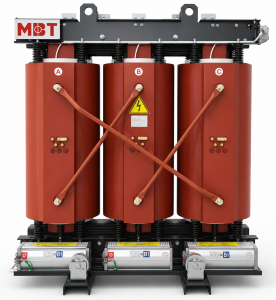
A cast resin transformer is a type of dry-type transformer that operates without insulating oil. Instead, it uses solid insulation materials and air cooling to ensure safe and stable performance under various operating conditions.
Among modern dry-type transformer solutions, cast resin transformers are widely recognized for their compact design, strong moisture resistance, and suitability for applications requiring high levels of operational safety.
In this article, MBT explains the essential aspects of cast resin transformers, including their structure, operating principle, key advantages, and typical applications.
In a cast resin transformer, the windings are encapsulated with epoxy resin. This insulation system enhances dielectric strength, protects the windings from moisture and environmental impact, and improves long-term operating reliability.
1. What is a cast resin transformer?
A cast resin transformer is a dry-type transformer in which the windings are fully encapsulated with epoxy resin. Unlike oil-immersed transformers, it does not rely on insulating oil for cooling or insulation, helping reduce the risks associated with oil leakage and fire hazards.
In modern electrical systems, cast resin transformers are often selected for projects that prioritize safety, operational reliability, and compact installation conditions.
The epoxy resin insulation system improves dielectric performance, minimizes the effects of humidity and dust, and helps maintain stable winding structure during long-term operation.
As a result, cast resin transformers are considered a reliable solution for clean, safe, and space-efficient power distribution systems.
Cast-resin-transformer
2. Main types of dry-type transformers
Dry-type transformers are generally divided into two common designs: cast resin transformers and VPI transformers. Although both designs operate without insulating oil, they differ in insulation technology and environmental protection capability.
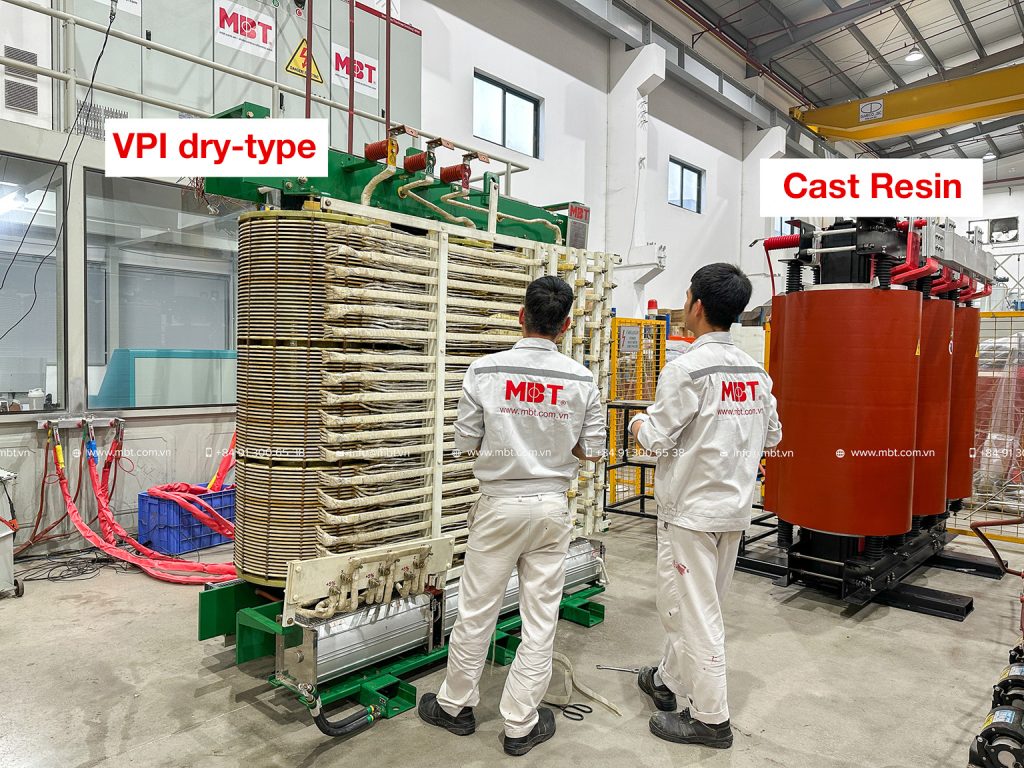
Main types of dry-type transformers
2.1 Cast resin transformer
In this design, the windings are encapsulated with epoxy resin. The solid insulation layer provides excellent dielectric strength, strong moisture resistance, and improved protection against dust and environmental conditions.
Cast resin transformers are commonly used in projects with strict requirements for:
- Fire safety
- Indoor installation
- Stable operation
- Compact substation design
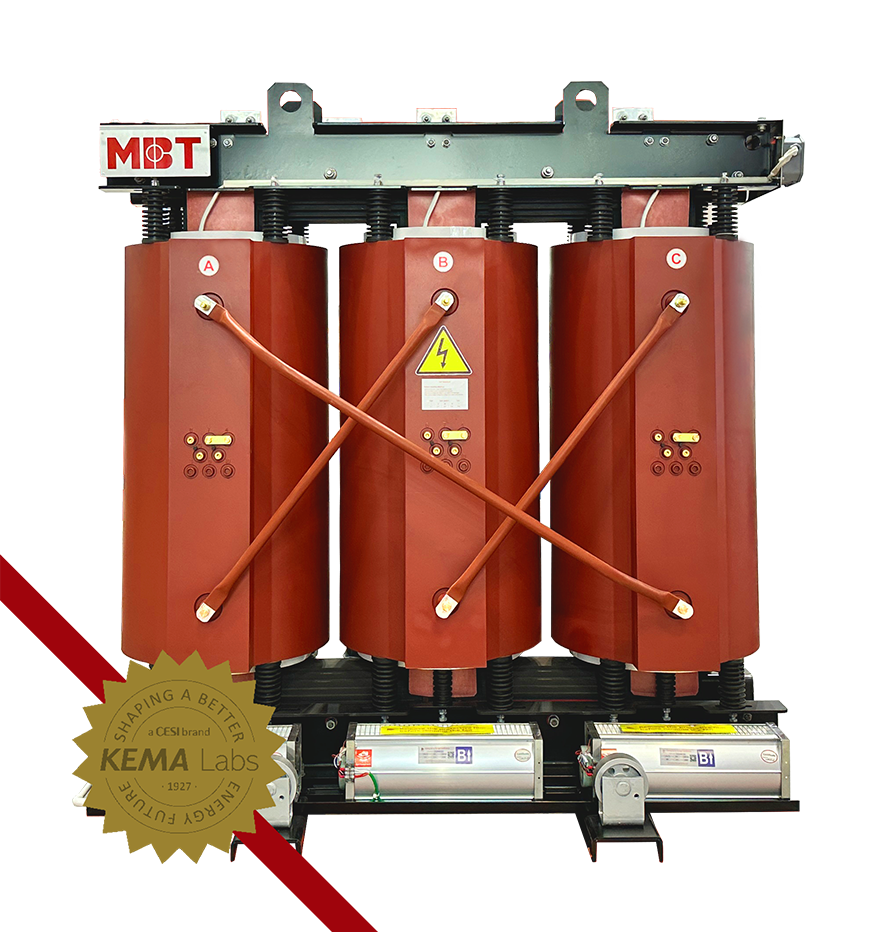
Cast-Resin Transformers
2.2 VPI transformer
VPI stands for Vacuum Pressure Impregnated. In this design, the windings are impregnated with insulating varnish under vacuum and pressure conditions, allowing the insulation material to penetrate deeply into the winding structure.
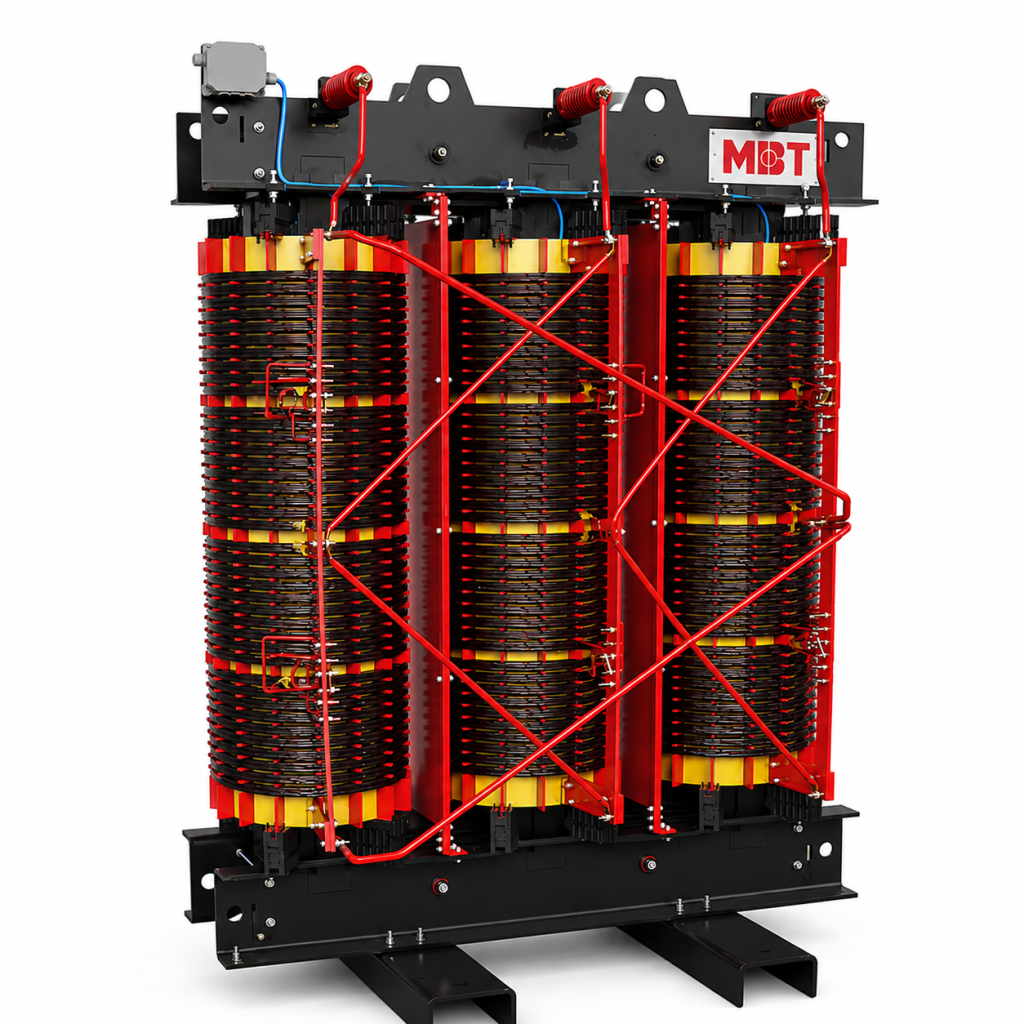
VPI-transformer
VPI transformers offer:
- Good mechanical strength
- Stable insulation performance
- Reliable operation in industrial environments
While cast resin transformers focus on solid epoxy encapsulation, VPI transformers emphasize deep insulation impregnation. The appropriate selection depends on project requirements, installation environment, and operational conditions.
3. Structure of a cast resin transformer
A cast resin transformer generally consists of three main component groups:
- Magnetic core
- Windings
- Insulation, cooling, and protection system
These components work together to ensure efficient voltage transformation, heat dissipation, and stable operation.
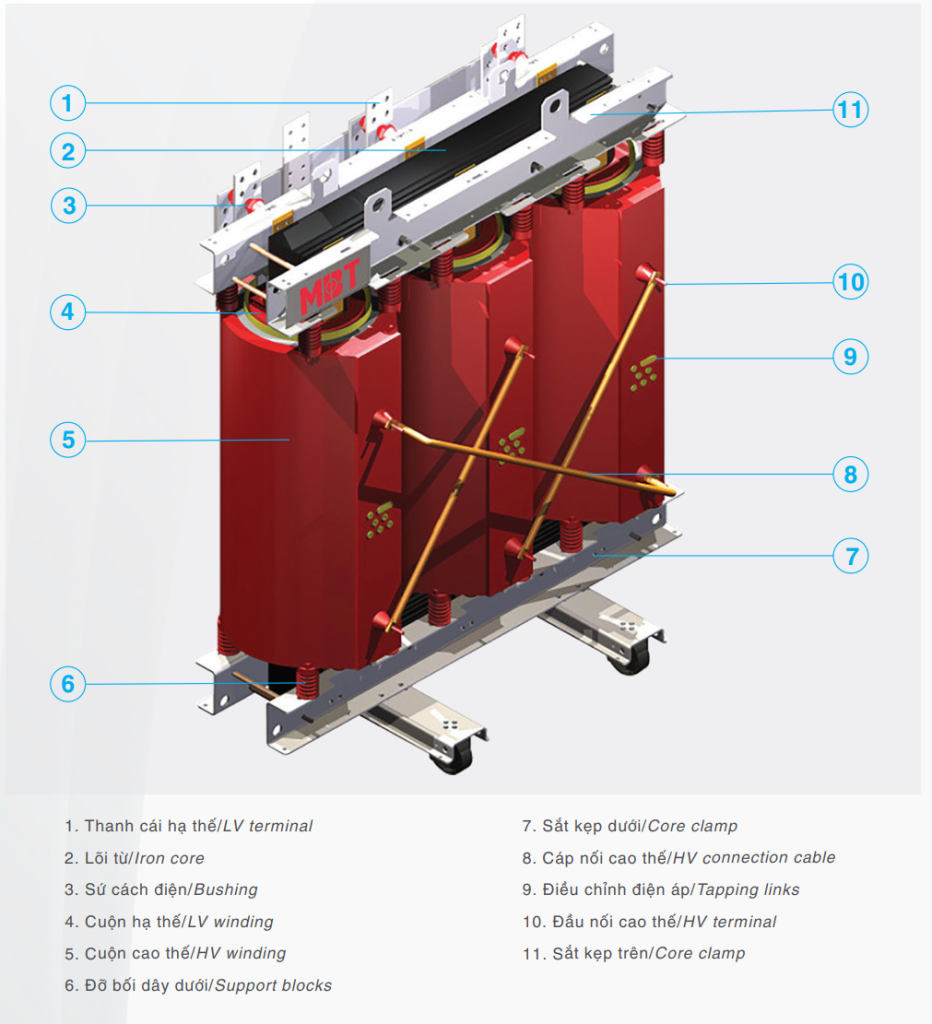
Dry-type transformer construction
3.1 Magnetic core
The magnetic core forms the magnetic circuit of the transformer and is typically manufactured from laminated electrical steel with high magnetic permeability.
The laminations are insulated from each other to reduce energy losses during operation.
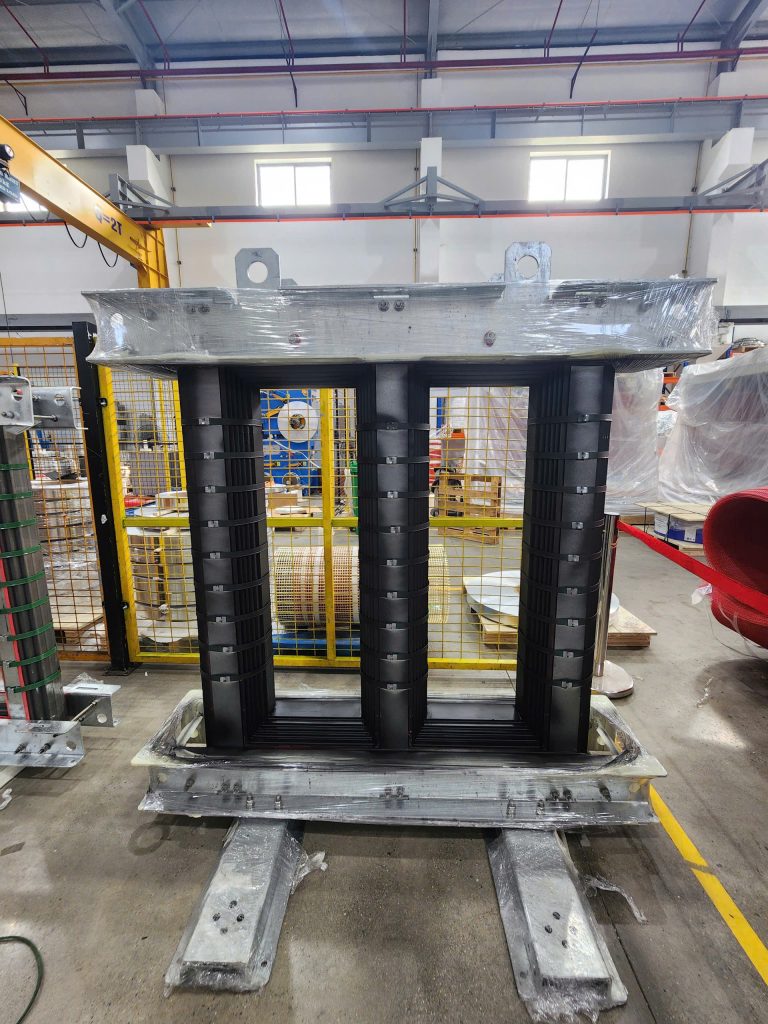
Magnetic-core-cast-resin-transformer
3.2 Key functions of the magnetic core:
- Reduce no-load losses
- Improve transformer efficiency
- Minimize noise and vibration
- Maintain long-term mechanical stability
A high-quality core design contributes significantly to transformer reliability and operating performance.
3.3 High-voltage and low-voltage windings
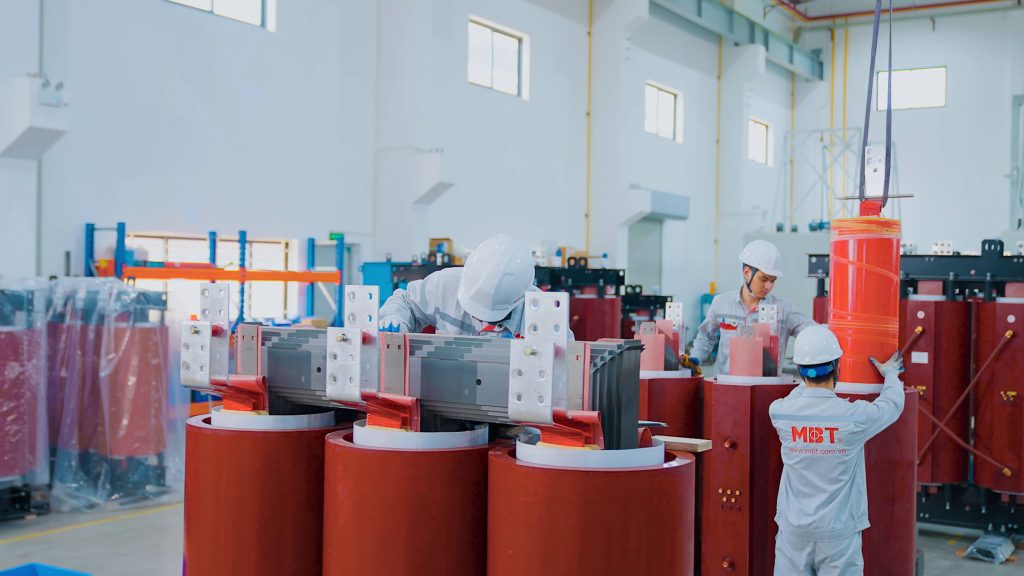
HV-LV-coil-installation-Cast-resin-transformer
The windings perform the voltage transformation process.
In a cast resin transformer:
- The high-voltage winding receives input power from the electrical grid
- The low-voltage winding supplies transformed voltage to the load system
Depending on project requirements, the windings may be manufactured from copper or aluminum conductors.
The epoxy resin encapsulation improves:
- Insulation performance
- Moisture resistance
- Mechanical strength
- Thermal stability
3.3.1High-voltage winding
Receives input voltage and generates magnetic flux inside the core.
3.3.2 Low-voltage winding
Provides the required output voltage to the electrical system.
3.3.3 Epoxy resin insulation
Protects the windings against humidity, dust, and mechanical stress.
4. Insulation, cooling, and protection system
One of the defining features of a cast resin transformer is its epoxy resin insulation system.
The resin layer enhances dielectric strength, limits moisture penetration, and helps reduce the risk of partial discharge during operation.
In addition to insulation, the transformer includes:
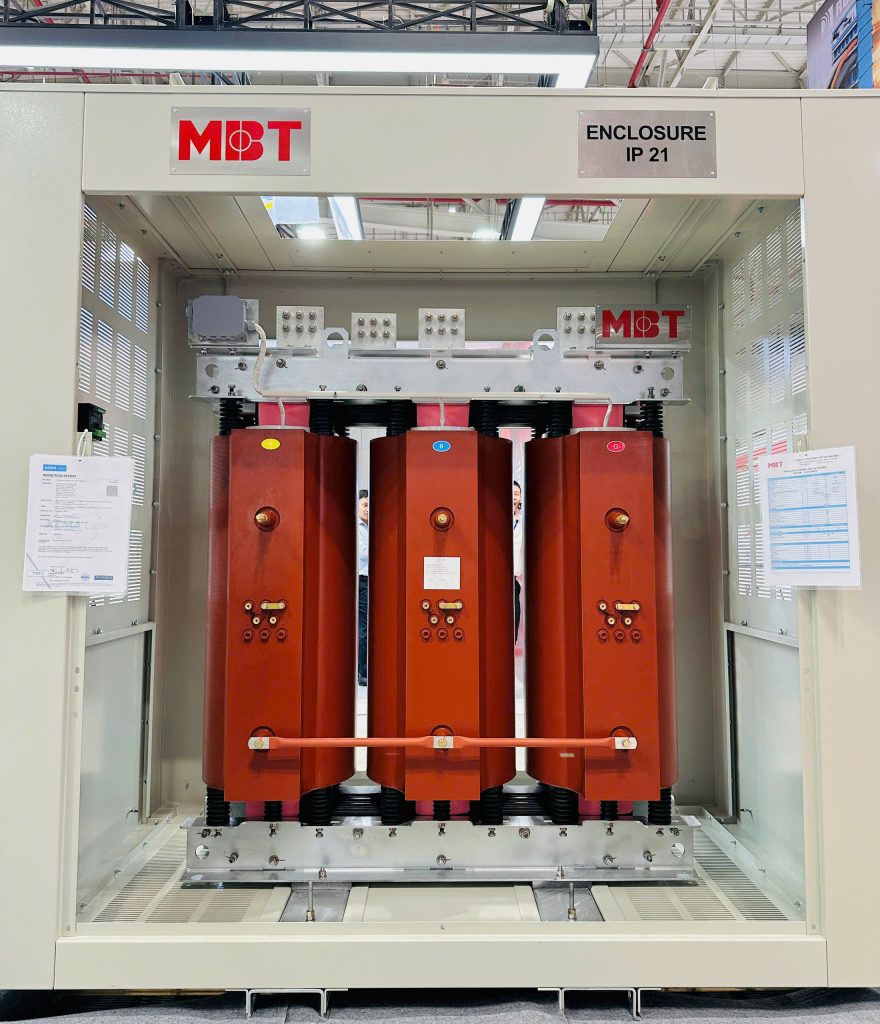
- Protective enclosure
- Cooling system
- Temperature monitoring devices
4.1 Protective enclosure
Helps protect internal components against:
- Dust
- Moisture
- Insects
- Mechanical impact
- External environmental conditions
4.2 Cooling system
Since cast resin transformers do not use oil cooling, heat dissipation is achieved through:
- Natural air cooling (AN)
- Forced air cooling (AF)
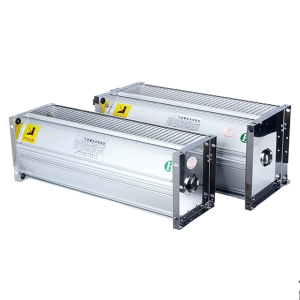
cooling fan
4.3 Temperature monitoring
Temperature sensors and controllers continuously monitor operating conditions and help protect the transformer from overheating.
Proper ventilation is essential for dry-type transformer installations to maintain long-term insulation performance and operational reliability.
5. Working principle of a cast resin transformer
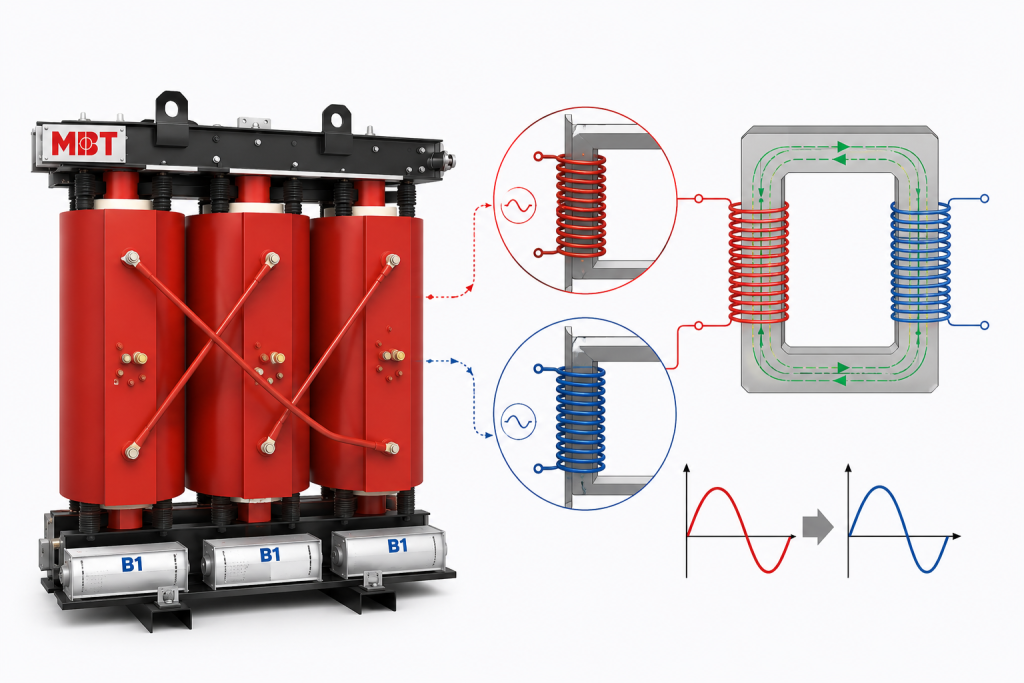
Working principle of a cast resin transformer
A cast resin transformer operates based on the principle of electromagnetic induction.
When alternating current flows through the high-voltage winding, a changing magnetic flux is generated in the magnetic core. This magnetic flux links with the low-voltage winding and induces output voltage.
The operating sequence can be summarized as follows:
- Input voltage is supplied to the high-voltage winding
- Magnetic flux is generated in the core
- Voltage is induced in the low-voltage winding
- Output voltage is delivered to the load system
The output voltage depends on the turns ratio between the high-voltage and low-voltage windings.
In power distribution systems, cast resin transformers are commonly used to step down medium voltage levels such as:
- 22kV to 0.4kV
- 35kV to 0.4kV
6. Key features of cast resin transformers
Cast resin transformers offer several operational advantages, particularly in projects requiring safe and clean electrical installations.
Safer operation
The transformer does not use insulating oil, reducing the risk of oil leakage and improving fire safety.
Excellent moisture resistance
Epoxy resin insulation helps protect the windings from humidity, dust, and environmental contamination.
Reduced maintenance
There is no need for periodic oil testing, filtration, or oil replacement.
Compact installation
The compact structure makes the transformer suitable for indoor substations and space-limited installations.
Stable operating performance
The solid insulation system helps maintain reliable operation under demanding environmental conditions.
However, compared with oil-immersed transformers of the same rating, cast resin transformers generally require higher initial investment costs.
7. Applications of cast resin transformers
Cast resin transformers are widely used in commercial, industrial, and infrastructure projects where safety and reliability are critical.
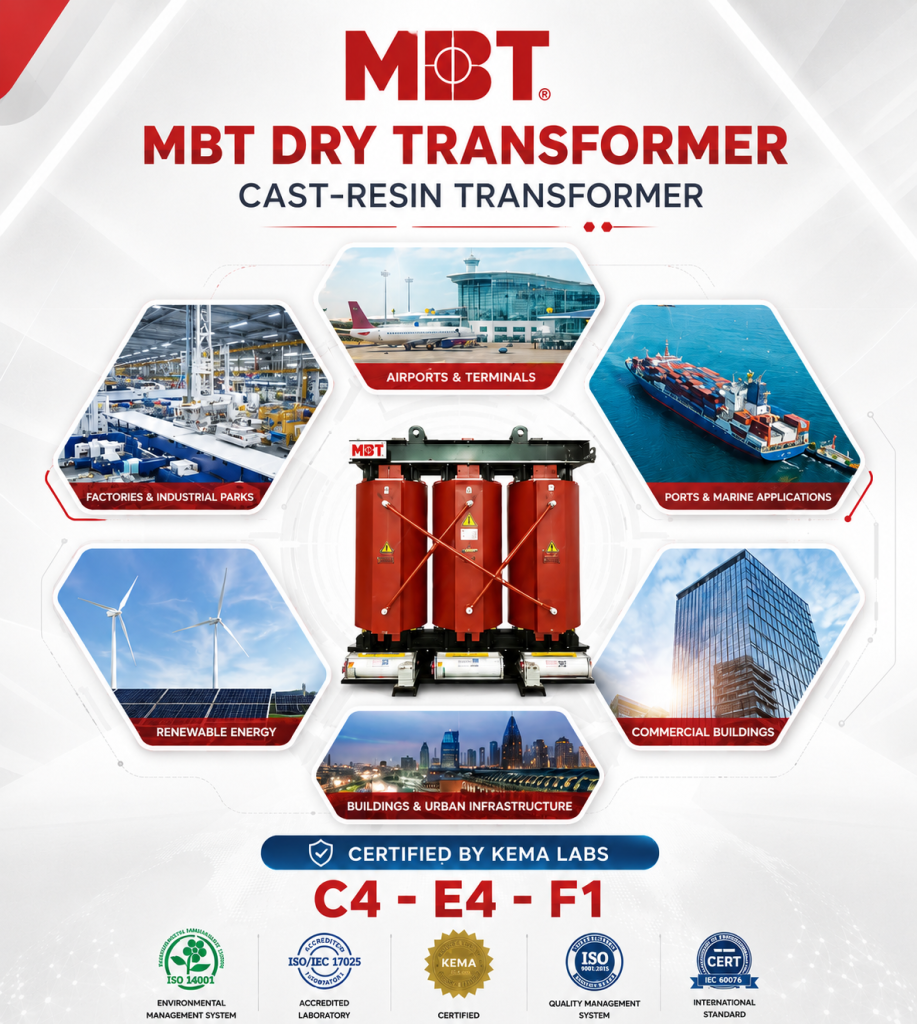
Applications of cast resin transformers
Commercial and public buildings
- High-rise buildings
- Shopping centers
- Hotels
- Hospitals
- Schools
Industrial facilities
- Factories
- Manufacturing plants
- Industrial zones
- Production systems
Critical infrastructure
- Data centers
- Railway stations
- Airports
- Indoor substations
- Technical basements
Their oil-free design and compact structure make them highly suitable for indoor and fire-sensitive environments.
8. When should a cast resin transformer be selected?
A cast resin transformer is particularly suitable for projects that require:
- High fire safety standards
- Moisture resistance
- Clean operating conditions
- Compact installation space
- Reliable indoor operation
It is also a practical solution when the transformer must be installed close to the load or inside buildings where oil-immersed transformers may be less suitable.
For large outdoor substations where initial investment cost is a major factor, both dry-type and oil-immersed transformer solutions should be carefully evaluated before final selection.
9. MBT cast resin transformers
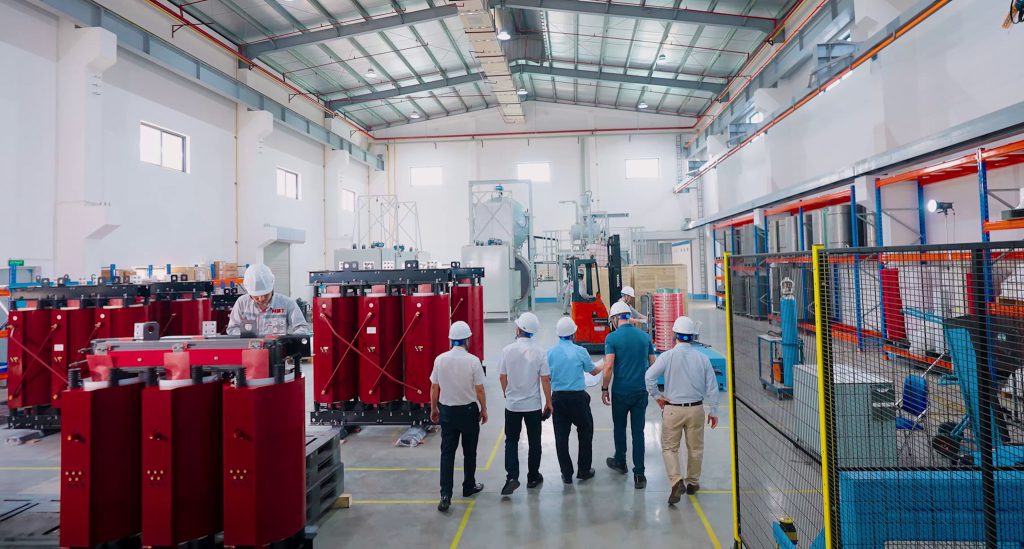
MBT-Cast-Resin-Transformers-factory
MBT cast resin transformers are developed using modern manufacturing technology to ensure durability, operational safety, and stable performance across various project conditions.
Advanced cast resin technology
The windings are manufactured using epoxy cast resin insulation technology to improve dielectric strength, moisture resistance, and mechanical protection.
International certification
MBT transformers have achieved CESI/KEMA Labs C4 – E4 – F1 certification in accordance with IEC 60076-11 standards.
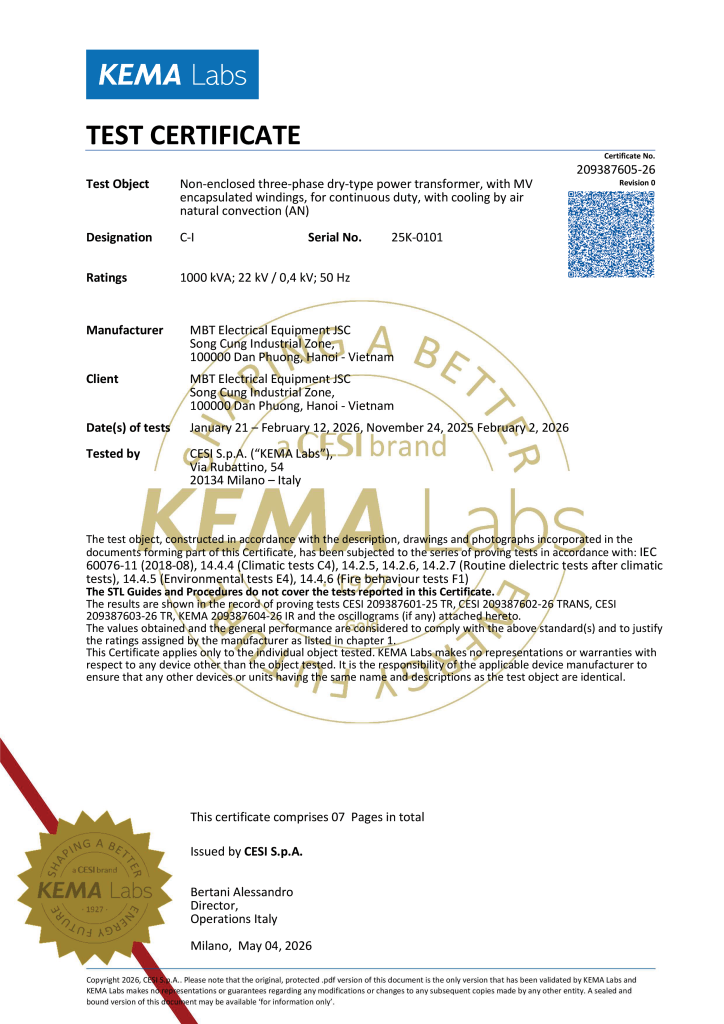
MBT – KEMA CERTIFICATE (C4, E4, F1)
European-oriented engineering
The product is developed based on European technology standards, making it suitable for projects with demanding quality and safety requirements.
Flexible project-based design
MBT provides customized transformer solutions based on:
- Power rating
- Voltage level
- Winding material
- Enclosure protection
- Monitoring accessories
With strong manufacturing capability and experience in electrical equipment production, MBT supplies cast resin transformer solutions for a wide range of commercial and industrial applications.